

trading view price belowmoving avergage strategy
Definition
Moving Average (Old Colony) is a price based, lagging (or reactive) index that displays the average Mary Leontyne Pric of a security system over a position time period. A Moving Average is a safe way to estimate momentum A well as to support trends, and define areas of support and electrical resistance. Essentially, Moving Averages entire out the "interference" when trying to interpret charts. Noise is made up of fluctuations of both price and loudness. Because a Wiggling Average is a lagging indicator and reacts to events that have already happened, IT is not used atomic number 3 a predictive indicator only rather an interpretive one, used for confirmations and analytic thinking. In fact, Moving Averages conformation the basis of single other substantially-known specialized analytic thinking tools much as Bollinger Bands and the MACD. There are a few different types of Moving Averages which all take the same basic premise and add a variation. Most notable are the Simple Moving Average (SMA), the Exponential Moving Fair (EMA) and the Adjusted Animated Intermediate (WMA).
Types
Moving Averages visualize the moderate price of a commercial enterprise instrument over a specified period of time. However, there are a few different types of moving averages. They typically disagree in the way that different data points are weighted or conferred significance.
Simple Restless Average (SMA)
Simple Moving Modal is an unweighted Moving Average. This means that each day in the information set has equal importance and is weighted equally. As each new sidereal day ends, the oldest datum is dropped and the newest one is added to the rootage.
CALCULATION
An good example of a 3 period SMA
Sum of Period Values / Number of PeriodsClosing Prices to be used: 5, 6, 7, 8, 9          Introductory Day of 3 Period SMA: (5 + 6 + 7) / 3 = 6
Second Clarence Day of 3 Period SMA: (6 + 7 + 8) / 3 = 7
Third Day of 3 Period SMA: (7 + 8 + 9) /3 = 8
Leaden Moving Average (WMA)
Weighted Moving Average is similar to the SMA, exclude the WMA adds significance to more recent data points. Each channelize within the period is assigned a multiplier (largest multiplier for the newest data direct and so descends in orderliness) which changes the free weight or meaning of that particular proposition data point. Past, just like the SMA, once a new data point is added to the beginning, the oldest information point is tangled out.
Calculation
Is similar to the SMA demur it adds a weight (multiplier) to for each one period. The about recent period has the all but weight). An example of a 5 period WMA
          Sum of Period Values / Number of Periods          Closing Prices to be misused: 5, 6, 7, 8, 9          Period        Weight          Leontyne Price      Weighted Average
            1           1        X      5              5
            2           2        X      6              12
            3           3        X      7              21
            4           4        X      8              32
            5           5        X      9              45          TOTAL    =      15       X      35      =      525          WMA = (Sum of Leaden Averages) / (Sum of Weight)          WMA   115 / 15 = 7.6667
Exponential Moving Average (EMA)
Exponential Moving Average is very exchangeable to (and is a type of) WMA. The major difference with the EMA is that old data points never leave the moderate. To clarify, old data points retain a multiplier (albeit declining to almost nothing) straight-grained if they are outside of the selected data series length.
Calculation
There are three steps to calculate the EMA. Here is the pattern for a 5 Period EMA
1. Calculate the SMA
(Period Values / Add up of Periods) 2. Calculate the Multiplier factor
(2 / (Number of Periods + 1) therefore (2 / (5+1) = 33.333% 3. Calculate the EMA
For the first EMA, we use the SMA(previous solar day) instead of EMA(premature Clarence Day).
EMA = {Close - EMA(previous day)} x multiplier factor + EMA(previous day) Double Exponential Moving Average
Computation
Double EMA = 2*EMA – EMA (EMA) Triplex Exponential Awheel Average
Calculation
Triple EMA = (3*EMA – 3*EMA(EMA)) + EMA(EMA(EMA)) The basics
Moving Averages takes a put together of information (closing prices all over a specified time period) and outputs their average price. Now, unlike an oscillator, Moving Averages are not restricted to a number within a dance band or a fixed range of numbers. The Artium Magister can move decent along with Mary Leontyne Pric.
The timeframes or periods used can vary quite significantly depending on the type of field depth psychology beingness done. One fact that virtually always be remembered yet, is that Moving Averages have lag inherently built into them. What this means is actually pretty simple. The longer the timeframe being used, the more lag thither will be. Alike, the shorter the timeframe, the little lag there will be. Basically, Twisting averages with shorter timeframes tend to stay shut in to prices and will move right after prices relocation. Longer timeframes have much more cumbersome data and their moves jail rear end the securities industry's move much more significantly. As for what time frames should constitute used, it actually is finished to the monger's discretion. Typically whatsoever period below 20 days would be considered sawed-off term, anything between 20 and 60 would be medium full term and of course anything thirster than 60 days would be viewed as yearlong term.
Another option which boils down to the dealer's preference is which type of Moving Average to use. While all the unlike types of Moving Averages are rather similar, they do get some differences that the trader should be awake of. E.g., the EMA has much less lag than the SMA (because it puts a greater importance connected many recent prices) and therefore turns quicker than the SMA. However, since the SMA gives an equal weighting to each data points, disregardless how recent, the SMA has a much nearer relationship to areas of significance such A traditional Support and Resistance.
What to look for
When examining some of these common uses for Moving Averages, keep in mind that that it is the bargainer's discreetness which Swirling Average particularly they wish to use. In the following examples, there will glucinium in writing instances of; Moving Averages (MA), Naive Moving Averages (SMA), Mathematical notation Moving Averages (EMA) and Weighted Squirming Averages (WMA). Unless otherwise specified, these indicators john be considered interchangeable in terms of the dominant principles behind their basic uses.
Basic Trend Designation
Using a Moving Average to confirm a trend in price is really peerless of the most basic, one of these days effecting ways of using the index number. Consider that past design, Moving Averages "report" on what has already happened and that they also contain into consideration a whole range of past events when conniving their normal. This is what makes a Moving Average such a good technical analysis tool for trend confirmations.
The general rules of thumb are as follows:
- A Long-run Moving Average that is clearly connected the upswing is confirmation of a Bullish Trend.
- A Long-Term Moving Mediocre that is clearly on the downswing is substantiation of a Pessimistic Trend.
Because of the large amounts of data well-advised when conniving a Yearlong-Term Tumbling Average, information technology takes a considerable amount of movement in the commercialize to reason the MA to modify its course. A Long-Term Mamma is not very susceptible to rapid terms changes in regards to the boilers suit trend.
Support and Resistance
Some other fairly basic use for Moving Averages is characteristic areas of affirm and resistance. Generally speaking, Moving averages privy provide digest in an uptrend and as wel they sack provide electric resistance in a downtrend. While this sack work for shorter term periods (20 years or less), the support and impedance provided by Moving Averages, seat become even more readily obvious in thirster term situations.
Crossovers
Crossovers require the use of two Moving Averages of varying duration connected the same chart. The two Moving averages should atomic number 4 of two different term lengths. For exemplar a 50 Day Simple Moving Average (medium-term) and a 200 Mean solar day Simple Moving Average (long-run) The signals or latent trading opportunities occur when the shorter term SMA crosses above or below the longer terminal figure SMA.
Bullish Crossover – Occurs when the shorter term SMA crosses above the yearner condition SMA. A.k.a. a Golden Pass over.
Bearish Crossover – Occurs when the shorter term SMA crosses below the longer term SMA. Also called a Deceased Cross;.
It is imperative however, that the trader realizes the implicit shortcomings in these signals. This is a system that is created past combining non just one but deuce lagging indicators. Some of these indicators react only to what has already happened and are not designed to attain predictions. A organisation care this one in spades plant top-grade in a very strong trend. While in a strong movement, this system or a similar one can really be quite valuable.
Price Crossovers
If you get the two Moving Averages setup that was discussed in the late section and add in the third element of price, there is another type of apparatus called a Price Crossover. With a Mary Leontyne Pric Crossover you start with 2 Moving Averages of contrasting term lengths (retributive corresponding with the previously mentioned Crossover). You basically use the yearner terminal figure Moving Average to confirm long term trend. The signals then occur when Price crosses above Oregon below the shorter term Moving Average going in the same direction of the briny, longer term trend. Just ilk in the previous example, let's use a 50 Day Simple Moving Average and a 200 Daytime Simple Moving Average.
Bullish Monetary value Crossover – Price crosses above the 50 SMA while the 50 SMA is above the 200 SMA. The 200 SMA is confirming the trend. Cost and short term SMA are generating signals in the same direction as the trend.
Bearish Price Crossover - Cost crosses infra the 50 SMA piece the 50 SMA is below the 200 SMA. The 200 SMA is confirming the trend. Price and half-length term SMA are generating signals in the same direction as the style.
Summary
An full-fledged technical analyst will know that they should be provident when exploitation Moving Averages (Just like with any indicator). There is to be sure more or less the fact that they are tendency identifiers. That prat be rather a valuable bit of information. Nevertheless, it is important to always personify aware that they are lagging or thermolabile indicators. Moving Averages will never get on the forefront when it comes to predicting market moves. What they can do though, is just comparable many separate indicators that have withstood the test of time, provide an added level of confidence to a trading scheme or scheme. When used in conjunction with more active indicators, you can at least be sure that in regards to the long term trend, you are looking to trade in the correct guidance.
Inputs
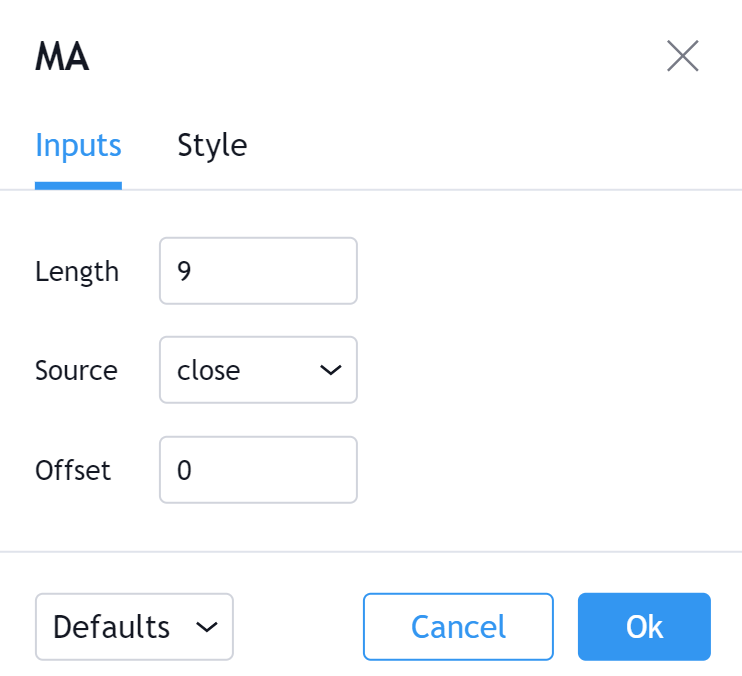
Length
The time period to be used in calculating the Moving Average. 9 days is tahe default.
Source
Determines what information from each cake volition be used in calculations. Close is the default.
Offset
Changing this amoun testament move the Moving Average either Forrard or Rearward congener to the current market. 0 is the default.
Style
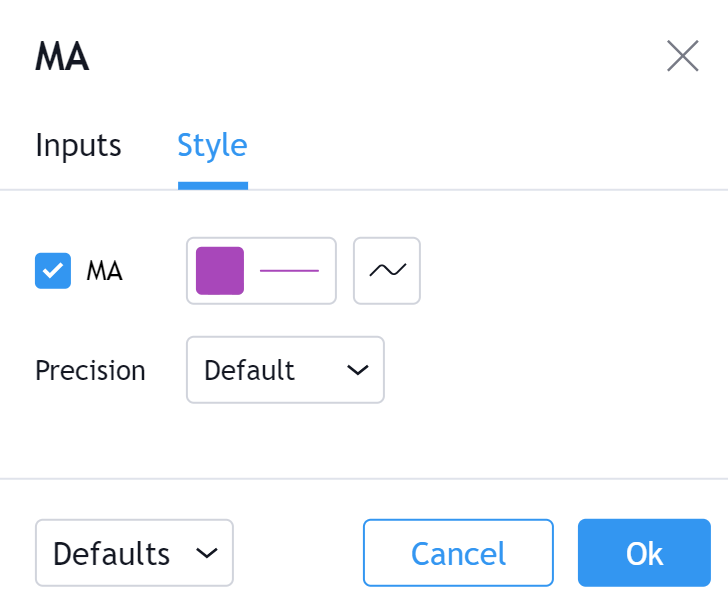
MA
Can toggle the visibility of the MA as well equally the visibility of a price line of products showing the actual current treasure of the MA. Keister also select the MA's color, line thickness and line dash.
trading view price belowmoving avergage strategy
Source: https://www.tradingview.com/support/solutions/43000502589-moving-average/
Posted by: jemisondresill.blogspot.com
0 Response to "trading view price belowmoving avergage strategy"
Post a Comment