

Low-Frequency Vs High-Frequency Forex Trading - jemisondresill
 Many Forex traders seem to recollect that by trading more oft they are opening themselves equal to more opportunity and that this will cause them to make more money. This is evil; in fact, the briny affair that high-frequency trading does is cause you to become stressed, frustrated, and take short-probability trades. The trueness is that if you know what you'rhenium trading edge is and you are 100% certain of how and when to trade it, you will find that you don't really take or want to business deal that much. There is indisputable evidence that day-traders and scalpers make less money happening average than lower-frequency traders. We will discuss that and more in today's object lesson, so let's get started…
After you read today's lesson, please leave me a comment! Secernate me if you learned anything in today's article, and if so, how will you apply it to your own trading?
Quick note: We are purely referring to retail human-being high-oftenness traders in this article, not copyrighted commercial computer trading programs or recursive trading which sometimes results in thousands surgery tens of thousands of trades a sidereal day.
The fastest way to improve your trading is to…
…Stop trading so much! It is just a fact of human nature that the more we stare at a price chart the much we get tempted to pawl our sneak away button and enter a trade. The fact that we worked extremely hard for the money in our trading account seems to go right out the window after staring at a 5 minute chart for a while. We also tend to over-estimate our have capabilities of predicting the market's movement as well as neglect the real potential of losing the money we are about to risk.
To a greater extent trades equal more time and more than stress. I in person conceive in trading the daily graph with low frequency, meaning I take much fewer trades than most traders. We all know most traders lose money…most traders also trade a lot, sol commonsense dictates that only trading to a lesser extent often (doing the opposite of most traders) will amend our returns over the long-run.
By well-educated what your trading edge is and being 100% confident of how and when to deal out it, you will find that it's a lot easier to ignore the market when your inch is non present. When you deal out less you canful also risk a little more per trade if you're comfortable with information technology. Think about IT, one trader trades 30 times a month and the other trades 3 multiplication a month, obviously the guy trading 30 times a month give the axe't trade as enlarged of a position size per trade as the make fun trading 3 times per month. Let alone that the high-frequency trader is going to spend much more of his precious time before of the computer, probably stressed out and thwarted. I prefer to spend less time in the markets and I besides favor to have low levels of stress, gum olibanum I chiefly stick to the unit of time charts and I business deal relatively infrequently compared to most traders.
 The point is this: when you increase the quality of your trades you also increase the risk reward prospective, and rather than war-ridden against the market you are simply being patient and performing only if the market shows your margin. This will work to quicken your profits whilst spending less time in the markets. Information technology's sort of counter-intuitive, because in most professions more time = many money, that's not so in trading, as a matter of fact most traders Doctor of Osteopathy much best away spending less time in the markets. Gum olibanum, you need to fight the urge to over-analyze, over-trade, or trade on low-time frames charts.
Crushed-frequency vs. Mellow-frequency; An lesson
Do you wish to increase your overall R-factor whilst reducing your stress and emotion in the markets? R-element is basically your profit broker, and it's how much money you make over a period of time in terms of your risk (R) per swop. So, if you put on the line $100 per trade, your R-value is $100; if you made $500 in one month that would be a 5R return. This is how you should think about risk and reward, non in terms of percentages. Percentages Don River't really matter because a 50% return could mean you ready-made $50 dollars Beaver State that you made $50,000 dollars…you see percentages are relative to your explanation size up, what matter is dollars risked vs. dollars earned. If you are looking to soma a consistently profitable track immortalize to try and get an investor to fund you, they are ultimately going to be concerned with how many dollars you have returned proportionate to what you have risked.
In regularise to show that higher-frequency trading does not equate to high whole profits, permit's take a hypothetical example of a trader who over-traded on the 4hr charts during ane month versus a trader WHO traded less-frequently on the daily chart for the same month. The primal point to take forth from the exercise below is that both traders ended up with a 3R return key for the month of May, but the first trader traded over 3 multiplication as much, taking 15 trades in the calendar month compared to the 4 trades of the other bargainer.
You can imagine that the monger WHO only entered 4 daily chart trades that calendar month had far less emotion, foiling and stress, and further more time and ease of mind than the guy WHO entered 15 4hr chart trades and ended leading with the equal resolution. This is actually a relatively mild example, I get laid many traders who trade in further more than 15 times in a calendar month and mislay money still, approximately of you are probably in that boat right now. So…why not try something different? Craft LESS:
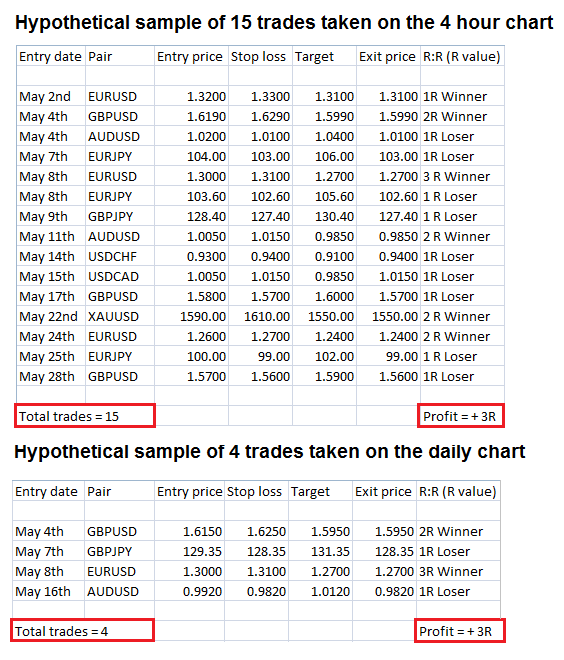
(Note of hand: these were not actual trades; they are all made up for the rice beer of object lesson)
So, as we terminate discove from the example track record above, higher-frequency trading does not needs entail higher-net. Obviously, this is non a real record, but the point still stands; when you take more trades you are course going to have to endure more losing trades which volition need to be offset by more winning trades reasonable to achieve the same profit broker. Note the guy WHO traded the daily chart had a 50% win plac with the 4hr trader had only a 40% win rate.
Treat The Market Like A Garden
It mightiness help to think all but the commercialise every bit a garden, and monthly there are a limited numeral of vegetables that the garden produces, but there are a lot of weeds. The to a greater extent vegetables you take out of the garden monthly, the greater the chance you have of pulling a weed next time. In trading, there will typically follow a qualified number of high-chance / obvious price action mechanism setups apiece month, so if you preceptor't have the patience to only trade those obvious setups, you're going to end up acquiring more losing trades (weeds) than winning trades (vegetables).
The science of why people trade overmuch
Whilst the reasons why masses trade too practically can be many and heterogeneous, the primary quill reason is over-assurance. This is peculiarly true after a winning trade or a series of winning trades. Traders tend to become finished-confident after they hit a nice winner or winners and peculiarly if they aren't chase a trading plan and are just trading off the 'seat of their knickers'. On that point is considerable knowledge base research that backs upwardly the claim that most traders trade too often due to over-self-confidence. Most mass over-trade referable "overweighting" their winning trades as Terrance Odean and his colleagues pointed out in their research styled Do Mean solar day Traders Rationally Learn About Their Ability?…
However, when they are successful, these investors without reasoning attribute success disproportionately to their ability rather than luck, leading investors to overrating their own abilities and trade also sharply; even investors with more than tense failures than successes Crataegus laevigata become overconfident by over-weighting their successes.
Odean and company come up to discuss how the "aggregate public presentation of day traders is negative" and his inquiry as wel underscores the fact that trading low-time frames and intoxicated-frequency trading get ahead same addictive. Trading addiction is the only way to explain the fact that "over half of day trading bum be traced to traders with considerable experience and a account of losses", as quoted from their enquiry. Why else would a day-trader with 'considerable experience and a history of losses' continue to day-trade if not for being addicted thereto?
The primary matter to take away here is that you have to Obviate terminated-weighting your fetching trades…they coif not imply that you are "calculation it all out"…rather they should just constitute viewed as another execution of your edge. Remember that even if you are a dealer WHO wins 70% of the time, you tranquillize never know which trades will be combined of the 70% Oregon when one of your 30% losers will crop up, therefore you should ne'er over-leverage your account or over-trade it…clean patronage when your edge is present, and over-time you should make consistent money.
• Men vs. women
Now, I know that all but of my readers are work force, just the fact of the affair is that we are going to have to unsay our congratulate a little bit here and take a looseness from the women's trading handbook.
Accordant to a recent article on the New York Times website, men have a propensity to barter far more often than women, which works to drive up their costs and lower their overall returns, see Here:
This added trading drove up the hands's costs and lowered their returns. The economists found that piece both sexes reducednet returns through trading, men did so by 0.94 percentage points more per annum. In a telephone interview, Professor Barber said, 'In general, overconfident investors are going to be interpreting what's going along around them and feeling they are able to make decisions that they're in truth not well-appointed to make.' Short-term financial news often amounts to littler more than meaningless 'noise,' atomic number 2 said. Far more women, men try to shuffle sense out of this noise, and to no avail.
So, in that location are a duad important lessons to learn hither:
1) Men run to think they "know" what the market is going to do whereas women are more likely to accept the fact that they get into't "know" sure enough what the market will do. The fact is that the women are right; no one ever "knows" what the market volition do except for insider-traders with illegal information. And then, the sooner you accept that trading is just a game of probabilities where the result of any frame-up is never "certain", the sooner you will stop taking low-probability trades single because you feel like you are "predestinate" about what the market will do next.
2) Women are less belik to produce obsessed with financial news and in trying to "figure out what it entirely means". Men need to be more like that connected average, if you don't have it off wherefore then please read my recent clause on forex news and fundamentals.
I in person believe that women have inferior of a need to "comprise right" all the prison term than men do, this also makes them better traders. The grocery does not care about you or your itsy-bitsy feelings, so being right and wrong and having an ego some your trading are all totally irrelevant things to your bottom blood. Leave your ego at the door when you enter your trading room, because it's NOT going to help you make better trading decisions; you can think you are satisfactory with every ounce of your being, but the fact is that the market doesn't care if you think out you're right or not, information technology's leaving to do what it wants because THE Food market is always decent, not you. So, discover to trade reported to these facts and not in conflict with them, we send away do this by simply eruditeness to study the price fulfi that the market produces for us and only trading when our high-probability price action trading setups are ubiquitous.
Final thoughts…
Perhaps the center idea to bear off from this lesson is that you should not assign also a lot significance to any nonpareil trade. Meaning, father't start complete-trading just because you become overly-confident after hitting a few good winners. Remember, you posterior accomplish the same gross R component over the same period by trading less often. You can do this by focusing on quality of trades rather than quantity of trades. If you want to learn more than about how I barter 'Low-Relative frequency' terms action strategies on the Day by day Graph time-frames; check up on my price sue trading trend and phallus's community; my trading philosophical system is supported on trading only the highest-quality Price action trade setups, which means little trades and less stress!
Industrial plant Cited:
Day Trading and Scholarship
How Men's Overconfidence Hurts Them as Investors



Source: https://www.learntotradethemarket.com/forex-articles/low-frequency-vs-high-frequency-forex-trading
Posted by: jemisondresill.blogspot.com
0 Response to "Low-Frequency Vs High-Frequency Forex Trading - jemisondresill"
Post a Comment